Does Gua Sha Actually Help Tension Headaches and Screen Eye Strain?
Quick Answer: Gua sha may help tension-type headaches that originate from muscular tightness in the jaw, temples, neck, and the base of the skull, because massage of those muscles is a recognised approach to that specific problem. It does not treat migraine, cluster headache, or eye conditions, and it does nothing directly for the eye itself. Use light pressure around the temples and orbital bone, work the neck and jaw where the tension usually actually lives, and treat any new, severe, or changing headache as a reason to see a clinician rather than reach for a stone.
The honest version is narrower than the claims and still worth doing.
Here is what the technique can reasonably be expected to do.

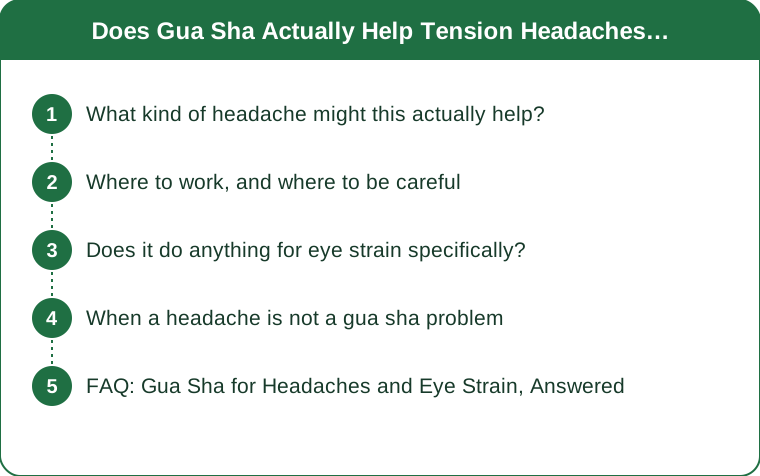
What kind of headache might this actually help?
Tension-type headache is the plausible target. It typically presents as a band-like pressure around the head, often with tenderness in the neck, shoulders, jaw, and the muscles at the base of the skull.
Massage and manual techniques for those muscles are a recognised part of managing tension headache, and gua sha is a form of massage with a tool rather than something categorically different.
Jaw clenching is a common and under-recognised contributor, and the masseter is easy to reach and responds well to sustained gentle work.
Screen posture drives a lot of it. A forward head position loads the suboccipital muscles at the base of the skull all day, and that is a classic referral pattern for headache felt at the temples and behind the eyes.
Migraine is a different condition with a different mechanism, and pressure or massage during an attack is uncomfortable for many people. Gua sha is not a migraine treatment.
And what you are most likely doing is relaxing muscle and prompting a break from a screen, both of which are genuinely useful. That is a modest claim and a real one. This is general information, not medical advice.
Where to work, and where to be careful
Start at the neck and the base of the skull, not the face. This is where the tension usually originates, and working it first often resolves more than any amount of temple work.
Work the masseter along the jaw with light to moderate pressure, in short upward strokes. Clench your teeth to find it, then relax completely before working it.
The temples take light pressure only. The skin is thin and the tissue is not deep, and heavy pressure here is a common cause of bruising rather than relief.
Around the eyes, stay on the orbital bone and never on the eyelid or the eye itself. Very light pressure, working outward along the bone.
Always use enough slip. Facial oil or a rich serum is essential - dragging a stone across dry skin causes irritation and microtears rather than benefit.
Angle the tool at roughly 15 degrees to the skin and use the flat edge rather than a corner. A steeper angle concentrates force and causes marking.
Avoid working over active breakouts, broken skin, sunburn, recent injectables, or any area of unexplained swelling. And skip it entirely if you are taking blood-thinning medication or bruise very easily without checking with your clinician first. This is general information, not medical advice.

Does it do anything for eye strain specifically?
Not for the eye itself, and it is worth being clear about that. Digital eye strain involves the focusing muscles inside the eye, reduced blink rate, and tear film changes, none of which are affected by external massage.
It may help the muscular tension that accompanies eye strain, particularly around the brow, temples, and the muscles you use to squint or frown at a screen.
The most effective interventions for screen eye strain are boring and well established: looking at something distant regularly, blinking deliberately, adjusting screen brightness to match the room, and getting your eyes tested.
The break itself may be doing much of the work. Three minutes of gua sha is three minutes of not looking at a screen with your eyes closed, which is a genuine intervention regardless of the tool.
Puffiness around the eyes is a separate claim with a more plausible mechanism, since gentle directional work may encourage fluid movement - though the effect is temporary.
If eye strain is persistent, comes with headaches, or your vision has changed, get an eye test. Uncorrected refractive error and outdated prescriptions are extremely common causes of both, and no amount of massage addresses them. This is general information, not medical advice.
When a headache is not a gua sha problem
Sudden severe headache, the worst you have experienced, needs urgent medical attention rather than any self-care technique.
A headache with fever, neck stiffness, rash, confusion, weakness, vision loss, or difficulty speaking needs urgent assessment.
A new headache pattern after 50, a headache that wakes you from sleep, or one that worsens steadily over days or weeks should be assessed by a clinician.
Headache following a head injury needs medical review, regardless of how minor the injury seemed.
Frequent headaches requiring regular painkillers can become medication-overuse headache, which is common, under-recognised, and requires specific management.
Anything that is changing in character, frequency, or severity deserves a proper assessment. Self-managing a changing headache is the risk here, not the gua sha itself.
None of this means gua sha is unsafe - it means it belongs in the category of comfort measures for ordinary muscular tension, not diagnosis or treatment. This is general information, not medical advice.
FAQ: Gua Sha for Headaches and Eye Strain, Answered
Can gua sha help a tension headache?
Possibly, for headaches driven by muscular tightness in the neck, jaw, temples, and base of the skull - massage of those muscles is a recognised approach to tension-type headache. It is not a treatment for migraine or cluster headache.
Does it help digital eye strain?
Not the eye itself. It may ease the surrounding muscular tension from squinting and frowning, and the enforced screen break is likely doing a good share of the work. Blinking, distance breaks, and an up-to-date prescription matter more.
Where should I start?
The neck and base of the skull rather than the face. That is usually where the tension originates, and working it first often resolves more than temple work does.
How much pressure around the temples and eyes?
Light. The skin is thin, the tissue is shallow, and heavy pressure here causes bruising rather than relief. Stay on the orbital bone and never on the eyelid.
Do I need oil?
Yes, always. Dragging a stone across dry skin causes irritation and microtears. Use a facial oil or rich serum and keep the tool at about 15 degrees to the skin.
When should I see a doctor instead?
Sudden severe headache, headache with fever or neck stiffness, confusion, vision changes, weakness, a new pattern after 50, one that wakes you, or anything steadily worsening. Also see an optician for persistent eye strain. This is general information, not medical advice.
TL;DR:
- Gua sha may help tension-type headaches driven by muscular tightness in the neck, jaw, temples, and base of the skull.
- It is not a treatment for migraine, cluster headache, or any eye condition, and it does nothing to the eye itself.
- Start at the neck and base of the skull, work the masseter with light to moderate pressure, and keep the temples and orbital area very light.
- Always use oil, keep the tool at about 15 degrees, and avoid broken skin, breakouts, sunburn, and recent injectables.
- For eye strain, distance breaks, deliberate blinking, and an up-to-date prescription do far more.
- Sudden severe headache, fever with neck stiffness, vision changes, a new pattern after 50, or a steadily worsening headache needs a clinician. This is general information, not medical advice.
The modest claim is the true one, and the modest claim is still worth three minutes.
Keep Reading
This article is for general informational and styling purposes only. Fit, sizing, and product availability may vary.