Gua Sha on Days You Woke Up Late: Your Questions, Answered
Quick Answer: On a rushed morning, keep the drainage direction and the slip, and cut the repetitions. Two minutes of correct, well-lubricated strokes moving from the centre of the face outward and then down the side of the neck gets most of the visible depuffing effect. What you lose by rushing is the relaxation, not the result.
The part people cut first is usually the part that mattered.
This is general information, not medical advice.

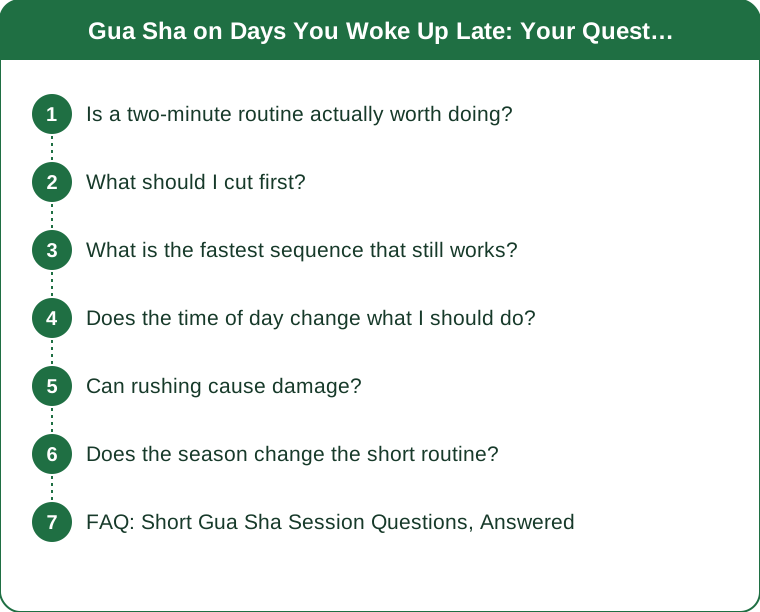
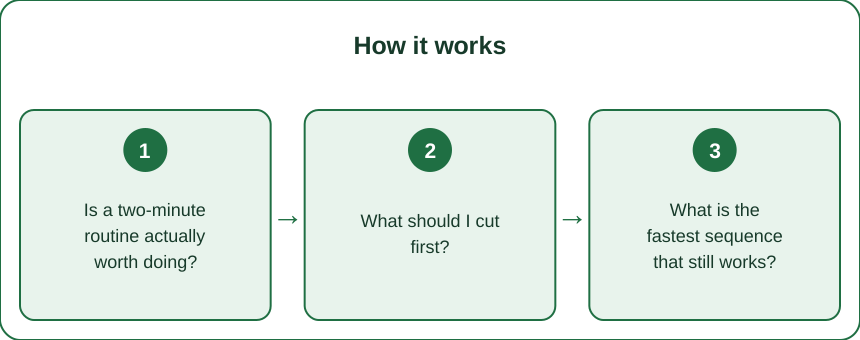
Is a two-minute routine actually worth doing?
Yes, and the reason is mechanical. The visible morning change from gua sha is fluid movement, not a change to the tissue itself. Fluid responds to direction and pressure within seconds, so a short session moves it and a long session moves slightly more of it.
The returns flatten fast. Most of the puffiness that will shift in a session shifts in the first few passes over each area. Repetitions beyond that are mostly for how it feels.
What a short session does not do is the slow, ten-minute nervous-system downshift that makes people describe gua sha as a ritual. That is real and it is the thing you are giving up.
A useful mental split: two minutes is maintenance, ten minutes is the treatment. Doing maintenance five mornings a week beats doing the treatment once.
What should I cut first?
Cut repetitions, not areas. Three strokes per section across the whole face beats fifteen strokes on one cheek. Lymph does not drain in isolation — the neck has to be cleared for the face to have somewhere to go.
Cut the fiddly detail work. Under-eye and around-nose passes take the most care for the least visible payoff on a rushed morning.
Do not cut the neck. This is the single most common shortcut and it is the one that makes the session pointless. Two or three downward passes along each side of the neck before touching the face is non-negotiable.
Do not cut the oil. A dry tool on dry skin drags, and drag is how people give themselves irritation and broken capillaries. If you are short on time you are moving faster, and moving faster with insufficient slip is the exact recipe for a mark.
What is the fastest sequence that still works?
Roughly 100 seconds, in this order.
Neck first, 20 seconds. Flat edge, light pressure, three passes down each side from below the ear to the collarbone.
Jaw, 20 seconds. From chin to earlobe, three passes each side, tool nearly flat against the skin.
Cheek, 25 seconds. From the side of the nose out toward the ear, three passes, then repeat slightly higher.
Brow and forehead, 25 seconds. From the centre outward, then up from the brow toward the hairline.
Finish at the neck again, 10 seconds. Two passes down each side. This is the part that closes the loop, and it is the one everyone skips.
Pressure throughout should be light — around the weight of the tool plus a little. Rushed sessions tend to get heavier, not lighter, which is backwards.

Does the time of day change what I should do?
Morning is for fluid, evening is for tension. Overnight, lying flat allows fluid to settle in the face, which is why morning puffiness exists and why a morning session shows the most immediate visible change.
Evening sessions suit jaw and temple work. Clenching accumulates through the day, so slower, more focused work along the masseter and temple makes more sense at night than at 7am.
If you only have time for one, pick morning for appearance and evening for how you feel. They are genuinely different goals.
Late-summer mornings complicate this slightly. Warm nights and higher salt intake both increase morning fluid retention, so the same routine can look more dramatic in August than it will in November.
Can rushing cause damage?
Speed alone does not, but the things that come with speed do. Insufficient product, heavier pressure to compensate for fewer passes, and dragging over dry patches are the three failure modes.
Redness that fades within a few minutes is normal. Redness that stays for hours, or small red dots, means the pressure was too high.
Never work over active, inflamed breakouts, and never over broken skin, regardless of how little time you have. Go around them.
If you are rushing, use more oil than usual, not less. It is the cheapest insurance against the only real risk here.
Does the season change the short routine?
Late summer means more fluid and more slip. Warm nights, higher salt intake and more alcohol in the social calendar all increase morning facial fluid, so August mornings often show the most dramatic before-and-after.
Skin is also oilier in heat, which means you may need less product than in winter to get adequate glide. Less is fine; none is not.
As the air dries in autumn, the tool starts to drag, and drag is the main cause of irritation. The same routine needs noticeably more oil in October than in August.
Cold tools feel better in warm weather and worse in cold weather. There is no rule here beyond comfort, and comfort affects whether you actually do it.
If you train in the morning, do gua sha after the session, not before. Facial flushing from exercise takes a while to settle, and working over already-flushed skin makes it harder to judge pressure.
FAQ: Short Gua Sha Session Questions, Answered
Is it better to skip entirely than to rush?
No. A correct short session is genuinely useful. Skipping the neck or skipping the oil is what makes a session not worth doing, and both of those are choices rather than consequences of time.
Can I do it over sunscreen or moisturiser?
Moisturiser is fine if it gives enough slip; many do not. Sunscreen is better applied after, since dragging a tool through it disturbs the film and reduces the coverage.
Does a cold tool help when I am short on time?
It does add a brief vasoconstriction effect, which slightly improves the immediate look. Keeping the tool in the fridge costs nothing and adds no time, so it is a reasonable shortcut to build in.
How many days a week does this need?
Most people notice more from short daily sessions than from occasional long ones, because the effect is temporary and refreshes each time.
Does the tool material matter for a quick session?
Barely. Jade, rose quartz and stainless steel all move fluid the same way. Steel holds cold longer, which is the only practical difference on a rushed morning.
Can I use my hands instead if I cannot find the tool?
Yes, and it works. Flat fingers with the same directions and the same light pressure produce a smaller version of the same effect. The tool is a convenience, not the mechanism.
Will I see a difference on camera?
Usually a modest one, most visible along the jawline and under the eyes, and it fades over a few hours. Expect a subtle change rather than a transformation, and expect more of it on mornings after a salty dinner or a late night.
TL;DR:
- Two minutes done correctly captures most of the visible morning effect.
- Cut repetitions, never the neck and never the oil.
- Neck, jaw, cheek, brow, neck again — roughly 100 seconds total.
- Rushing raises the risk of heavy pressure and drag, so use more slip, not less.
- Frequency beats duration for the puffiness effect, since it is temporary either way.
The long ritual is lovely. The short version is what actually gets done on a Tuesday.
This is general information, not medical advice.
Keep Reading
This article is for general informational and styling purposes only. Fit, sizing, and product availability may vary.