Does Gua Sha Work Differently at the End of Summer?
Quick Answer: Yes, in specific ways. Sun-exposed skin is more reactive, so the same pressure that was comfortable in June can produce redness or irritation now. Falling humidity means slip products evaporate faster, and gua sha on insufficiently slippery skin is the main cause of the tugging and irritation people blame on the stone. And late-summer fluid retention patterns differ - heat-related swelling responds well to lymphatic work while dehydration-related puffiness does not. The practice does not change, but the pressure, the product amount and the expectations all should.
Gua sha is one of those practices where small technique details make a large difference in results, and the conditions at the end of August change several of those details at once.
Here are the questions worth answering before your next session.

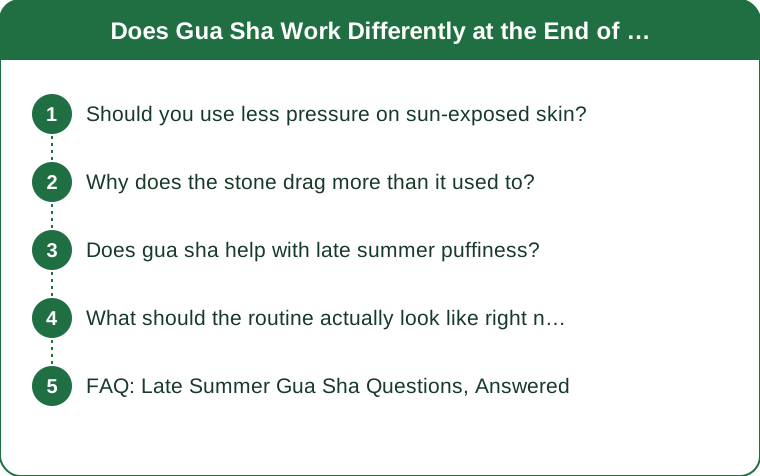
Should you use less pressure on sun-exposed skin?
Yes, and this is the most important seasonal adjustment.
Skin that has had a summer of UV exposure has an altered barrier and a lower threshold for inflammatory response. The same mechanical pressure that produced a pleasant flush in May can produce lasting redness or broken capillaries now.
This is more than theoretical. UV exposure degrades the collagen and elastin in the dermis and weakens capillary walls, so the tissue is genuinely more fragile at the end of summer than at the start.
The correct pressure for facial gua sha is light regardless of season - firm enough to move the skin with the stone, not firm enough to drag through it. If you are seeing redness that persists more than a few minutes, that is too much pressure in any season and definitely too much now.
The test: the stone should glide, and your skin should move with it as a unit. If the stone is moving across the skin surface rather than moving the skin, there is not enough slip and you will compensate with pressure.
If you have any active sunburn, peeling, or new pigmentation, wait. Mechanical work on inflamed skin can worsen post-inflammatory pigmentation, and late August is the worst month of the year for that risk.
Why does the stone drag more than it used to?
Because your slip product is evaporating faster and your skin is drier underneath it.
Gua sha requires a continuous slip layer, and the amount needed depends on how fast that layer breaks down. In humid conditions an oil or serum stays workable for a long time. In dry late-August air with the cooling running, the same amount is gone in half the time.
The usual response is to press harder to keep the stone moving, which is exactly wrong and is the mechanism behind most gua sha irritation.
Use more product than you did in July - noticeably more - and reapply mid-session if the glide changes. A face oil is more reliable than a water-based serum in dry conditions because it does not evaporate.
There is also a skin-side factor. A summer-depleted barrier holds less water, so the skin surface itself is rougher and creates more friction with the stone. That is a reason to spend a couple of weeks on barrier repair before expecting gua sha to feel the way it used to.
And check the stone. A chipped or micro-scratched stone drags in a way a smooth one does not, and stones that have been knocked around in a bag all summer accumulate damage. Run a fingertip along the working edge - any catch you can feel, your face can feel more.

Does gua sha help with late summer puffiness?
It depends entirely on what is causing the puffiness, and late August produces two different kinds.
Heat-related fluid retention - vasodilation and fluid pooling from hot weather - responds well to lymphatic-direction gua sha. The fluid is in the interstitial space and gentle directional work genuinely helps move it. This is the puffiness that improves visibly within one session.
Dehydration-related puffiness is different. When you are underhydrated, the body retains fluid, and the retention is systemic rather than local. Gua sha will not meaningfully change it - drinking water and reducing sodium will. Working harder on the face because it is not responding is how people end up with irritation.
There is a third pattern specific to this time of year: allergy-related puffiness. Late August is a significant pollen period in much of the country, and the associated under-eye congestion is inflammatory rather than lymphatic. Gua sha over inflamed tissue does not help and can aggravate.
The distinguishing question is timing. Puffiness that is worst in the morning and improves through the day is usually fluid distribution, which responds. Puffiness that is constant, or worse in the evening, is usually systemic or inflammatory, which does not.
Directional technique matters for the lymphatic work: always toward the lymph nodes - from the center of the face outward and down toward the neck, finishing at the collarbone. Working in the wrong direction does nothing useful.
What should the routine actually look like right now?
Shorter, lighter, and with more product - plus two weeks of barrier work first if the skin is strained.
If your skin is tight, stinging or flaking, pause gua sha for two weeks and focus on barrier repair. Ceramides, cholesterol and fatty acids, plus humectants applied to damp skin. Gua sha on a compromised barrier is a net negative, and this is the most common late-summer mistake.
When you resume: generous oil, light pressure, three to five passes per area rather than the ten you might do in winter, and stop at the first sign of redness that does not fade in a minute.
Timing matters more now. Morning sessions address overnight fluid distribution and are the most visibly effective. Evening sessions before bed help with tension in the jaw and temples, which is a different goal and does not need the same lymphatic direction.
Keep the stone cool but not cold. A stone from the refrigerator feels excellent on hot skin and is genuinely constricting for redness, but on a compromised barrier in cool weather it is unnecessary. Room temperature is fine.
And sunscreen after, without exception. Increased circulation in the skin does not increase UV sensitivity directly, but you have just spent ten minutes working on skin that is already sun-stressed, and September UV is still substantial.
This is general information, not medical advice. Persistent facial swelling, one-sided swelling, or skin changes that do not resolve deserve a clinical opinion rather than a technique adjustment.
FAQ: Late Summer Gua Sha Questions, Answered
Can I do gua sha over a tan?
Over an established tan, yes with normal precautions. Over skin that is still red, warm or peeling from recent sun, no - mechanical work on inflamed skin is one of the more reliable ways to trigger post-inflammatory pigmentation, and skin that has just been burned is at its most vulnerable to it.
How often should I be doing it at this time of year?
Three to four times a week is plenty, and less if the skin is showing barrier strain. Daily gua sha is a common recommendation and it works fine on robust skin in stable conditions - late August is neither, and reducing frequency for a few weeks costs you very little.
Should I switch products for the season?
Generally yes. If you have been using a light water-based serum for slip through the humid months, an oil or balm gives you a longer working time in drier air and reduces the temptation to press harder. The switch also supports the barrier repair that most skin needs at this point in the year.
TL;DR:
- Sun-exposed skin is more reactive - use less pressure than you did in June, and stop at persistent redness.
- Dry air evaporates your slip product faster, and pressing harder to compensate is the main cause of irritation.
- Use more oil than in July, and reapply mid-session.
- Heat-related puffiness responds; dehydration and allergy puffiness does not. Morning-worst that improves through the day is the responsive kind.
- Pause entirely for two weeks if the barrier is tight, stinging or flaking.
- Check the stone edge for chips picked up over the summer.
This is general information, not medical advice. The practice is the same - the skin underneath it has had a hard three months and deserves a lighter hand for a few weeks.
Keep Reading
This article is for general informational and styling purposes only. Fit, sizing, and product availability may vary.