Gua Sha Before or After Skincare: Does the Order Actually Matter?
Quick Answer: Gua sha should come after applying a facial oil or a slippery serum, not on bare skin or after a heavy cream, since the tool needs enough glide to move smoothly without dragging skin — most practitioners recommend it as one of the last steps, right after your lightest slip-providing product and before a final moisturizer or SPF.
The specific order matters less than one thing: your skin has to be slippery enough that the tool glides rather than tugs.
Why does dragging on dry skin matter?
Using gua sha on unlubricated skin can cause micro-tears and irritation over repeated sessions, since the tool’s edge relies on smooth glide to work the way it’s designed to — this is the most common mistake behind gua sha-related redness complaints.
Does product order affect the massage’s actual benefit?
The order affects comfort and glide more than the underlying benefit, since gua sha’s main documented effects (temporary lymphatic fluid movement and blood flow increase) come from the mechanical motion itself, not from which specific product happens to be underneath it.

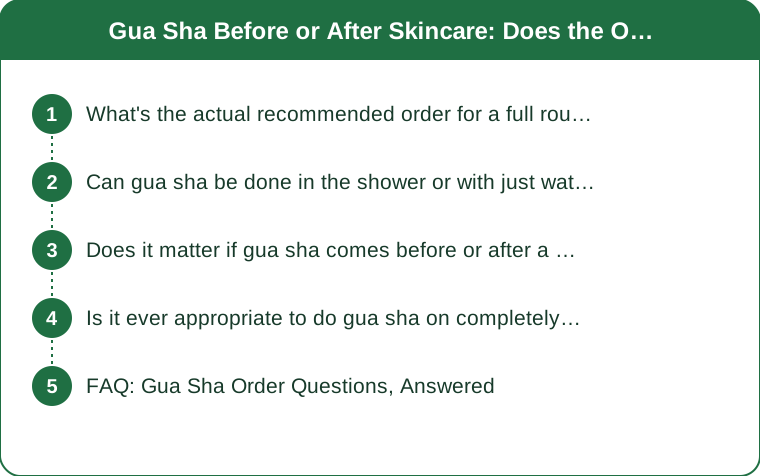
What’s the actual recommended order for a full routine?
Cleanse, apply a lightweight serum or facial oil, use gua sha while that product still provides slip, then follow with a heavier moisturizer or SPF as your final step. Using gua sha before a heavier cream is applied means the tool works with the product’s slip rather than getting stuck sliding through a thick layer already sitting on top.
Can gua sha be done in the shower or with just water?
Yes, some practitioners do a lighter version in the shower with warm water and a body oil for body gua sha specifically, but facial gua sha generally works better with an actual facial oil or serum, since plain water evaporates too quickly to maintain the glide needed for a full session.

Does it matter if gua sha comes before or after a facial massage or roller?
Gua sha is generally considered a more targeted, deeper-pressure tool compared to a facial roller, so many routines that use both do gua sha first while skin is freshest and most receptive, then use a roller afterward as a lighter, cooling finishing step, though this order isn’t a strict rule.
Is it ever appropriate to do gua sha on completely dry skin?
Generally no — even a light mist or facial water isn’t enough slip for comfortable, safe gua sha use. An actual oil-based product (rather than a water-based gel, which absorbs too fast) tends to provide the longest-lasting glide for a full session without needing to reapply mid-routine.
FAQ: Gua Sha Order Questions, Answered
Should gua sha come before or after sunscreen in a morning routine?
Before — gua sha should be done on the slip-providing serum or oil layer, with sunscreen applied afterward as the final step, since moving a tool over sunscreen can disturb its even coverage.
Does using gua sha after a face mask work well?
It can, particularly after a hydrating mask, since the residual product often provides enough slip on its own — just confirm there’s still enough glide left before starting.
Is there a wrong order that could actually harm skin, not just feel less effective?
Using gua sha directly after a chemical exfoliant (like a retinoid or acid) isn’t recommended, since the combined mechanical pressure and active ingredient can increase irritation risk on already-sensitized skin.
TL;DR:
- Gua sha works best with a lightweight oil or serum underneath for proper glide
- Doing it on dry skin risks micro-tears and irritation, not just discomfort
- The heaviest moisturizer or SPF should go on after gua sha, not before
- Pair it with a chemical exfoliant with caution, since combined irritation risk rises
Getting the order right is less about ritual and more about physics — enough slip, applied at the right point, is what makes the tool actually do its job comfortably.
Keep Reading
This article is for general informational and styling purposes only. Fit, sizing, and product availability may vary.