Gua Sha for Jaw Tension: A Routine for Clenchers
Quick Answer: Gua sha can genuinely ease the surface tension of a clenched jaw - the masseter and temporalis muscles respond to slow, light, oiled strokes the way any tight muscle responds to massage. The four-minute routine: sweep from chin along the jawline to the ear, work the masseter belly in small passes, circle the temples, finish with down-the-neck strokes. What it cannot do is treat the cause - stress, sleep bruxism, or a jaw disorder - so clenchers pair it with habit changes, and grinders talk to a dentist.
The jaw is where a surprising number of people store the day - and increasingly the phone. If your morning face feels pre-tightened, the masseter version of gua sha is one of the more pleasant four-minute experiments available, provided you hold it to honest expectations.

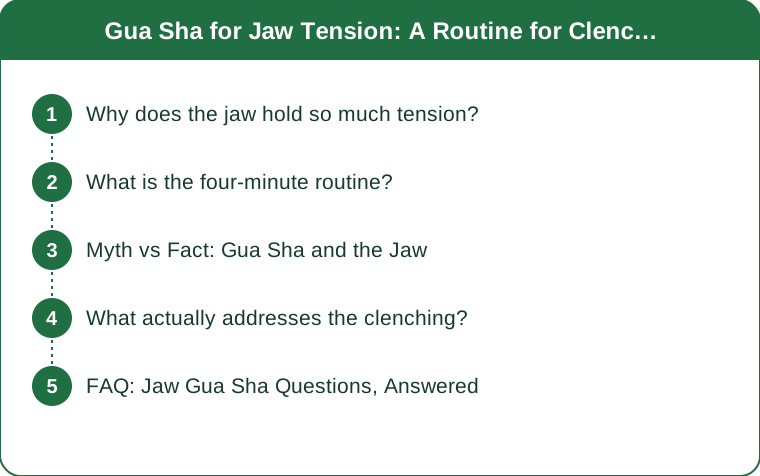
Why does the jaw hold so much tension?
Because it is the strongest muscle system in the body for its size, wired directly to stress, and almost never consciously relaxed.
The masseter is a force machine. The thick muscle you feel bulge when you bite down can generate enormous pressure - chewing needs a fraction of its capacity, which means a clenching habit runs a powerful muscle at constant partial contraction for hours. Any muscle treated that way ends up tender, shortened, and tired; the masseter is simply the one doing it on your face.
Clenching is a stress behavior with modern accelerants. Concentration clench - jaw set while emailing, driving, lifting, scrolling - is near-universal, and screen posture adds a mechanical layer: the forward-dropped head changes how the jaw hangs and invites the muscles to brace. Many people clench most in exactly the situations they consider relaxing, phone in hand.
Night grinding is its own category. Sleep bruxism happens outside awareness and can load the teeth and jaw joints far harder than any daytime habit. The tells: waking with jaw fatigue or headache at the temples, teeth marks scalloping the tongue edge, a partner who hears it, or a dentist noticing wear. This category is exactly where self-massage stops being a plan and a dental conversation starts being one.
And jaw tension radiates. The temporalis muscle fans across the temples - clench and you can feel it fire - which is why a tight jaw so often wears a tension-headache costume. Ear fullness, cheek soreness, and neck tightness join the referral map. Loosening the jaw surface muscles often quiets several of these at once, which is the honest core of gua sha’s appeal here.
What is the four-minute routine?
Slow, light, oiled, and downward at the finish - that is the whole technology.
Prep: clean skin, a few drops of facial oil, and the tool’s long curved edge. The oil is non-negotiable - a dry tool drags skin instead of gliding over muscle. Pressure calibration: the skin should move slightly and flush faintly pink at most; this is a relaxation practice, and the petechiae-raising pressure of traditional body gua sha has no place on the face.
Minute one - the jawline sweep. Tool edge at the center of the chin, glide slowly along the jawbone to the earlobe. Five to eight passes per side. This is the orientation stroke - long, lazy, and calming.
Minute two - the masseter itself. Clench lightly once to find the muscle belly at the back of the cheek, then unclench and work small, slow upward-and-back passes over it, chin toward ear. Tender spots get three extra unhurried passes, not extra pressure. Teeth apart, lips closed, breathing slow - the muscle cannot release while it is being used.
Minute three - temples and under-cheekbone. Small circles over the temples where the temporalis lives, then gentle sweeps from beside the nose out along the underside of the cheekbone to the ear.
Minute four - the neck finish. Long downward strokes from behind the ears along the sides of the neck toward the collarbone, five per side. Every facial routine ends downward - it feels like the tension has somewhere to go, and it closes the loop calmly.
Dosage: once daily or a few evenings a week, ideally attached to an existing anchor - after the nighttime cleanse is the classic slot. Evening beats morning for clenchers, since the point is to un-set the day’s jaw before sleep.

Myth vs Fact: Gua Sha and the Jaw
Myth: Gua sha treats TMJ disorders. Fact: It can ease the muscular layer - surface tension in the masseter and temples - which is real relief for tension-type tightness. Joint clicking, locking, restricted opening, or persistent pain belong to a dentist, physician, or physical therapist; a jade tool addresses none of the structures involved. Symptom relief and treatment are different words on purpose.
Myth: Harder pressure works deeper. Fact: On facial muscles, pressure past light-to-moderate triggers guarding - the muscle braces against the assault, which is the opposite of release - and risks broken capillaries on thin facial skin. The productive dose is embarrassingly gentle. If it leaves marks on your face, it was too much.
Myth: Daily gua sha will slim the masseter and sharpen the jawline. Fact: The de-puffed, more defined look after a session is real and temporary - fluid moved, muscles relaxed. A masseter enlarged by chronic clenching only genuinely reduces when the clenching does; massage cannot shrink a muscle that keeps working overtime nightly. The photos-after-one-week genre is lighting and hope.
Myth: The stone matters - jade versus rose quartz versus steel. Fact: Shape and technique matter; mineral does not. A curved edge that fits the jawline, kept clean, is the entire equipment requirement. The material differences are aesthetic and the price differences are marketing.
Myth: If it helps, more must help more. Fact: The jaw responds to consistency, not intensity - four gentle minutes most evenings beats twenty aggressive minutes on Sunday. Overworked facial muscles feel worse the next day, which reads as the tool failing when it was actually the dose.
What actually addresses the clenching?
The tool relaxes the muscle; these change what the muscle does tomorrow.
Install the resting-jaw cue. The physiologic rest position: lips together, teeth apart, tongue resting on the roof of the mouth. Teeth should touch only for chewing - total contact time in a healthy day is measured in minutes. The classic method is environmental: a small dot sticker on the laptop, the car dash, the phone case, each one asking - are the teeth touching? For most daytime clenchers this single cue, practiced for a few weeks, outperforms every product.
Break the screen-jaw circuit. Clenching concentrates hardest during focus and scrolling. Raising the phone toward eye level, un-jutting the chin, and adding a jaw check to natural pauses - red lights, elevator waits, kettle boils - interrupts the pattern where it forms.
Downshift the evening on purpose. Clenchers who arrive at bedtime wound-up grind harder. The routine above works partly because it is four minutes of slow breathing with hands on the face - any wind-down that lowers arousal before sleep (warm shower, stretching, screens ending earlier) is jaw care wearing a different name.
Let the dentist handle the night shift. For true sleep grinders, a professionally fitted night guard protects teeth and often reduces morning symptoms - and a dentist can spot wear patterns you cannot feel. Morning jaw pain, temple headaches, or a grinding report from a partner is the referral trigger; boil-and-bite guards from the drugstore are a stopgap, not the destination.
And know the escalation list: pain that persists or worsens, clicking with locking, difficulty opening, ear pain, or bite changes - those go to a professional regardless of how nice the massage feels. General information, not medical advice.
FAQ: Jaw Gua Sha Questions, Answered
Does gua sha actually help jaw clenching?
It reliably eases the symptom - tight, tender masseter and temple muscles respond to slow, light massage, and many clenchers feel looser immediately and sleep better with an evening routine. It does not touch the cause: the daytime habit answers to awareness cues, and night grinding answers to a dentist. Use it as the pleasant half of a two-part plan.
Which direction should I use the tool on my jaw?
Work from the center of the face outward and slightly upward - chin along the jawline to the ear, masseter belly toward the ear, nose along the under-cheekbone to the ear - then finish with downward strokes from behind the ears along the neck to the collarbone. Slow beats fast everywhere, and light beats firm.
How often should I do the routine?
Four minutes once daily, or most evenings, is the productive dose - consistency outperforms intensity on facial muscles. Attach it to the nighttime skincare slot so it happens automatically. If the jaw feels worse the day after a session, the pressure was too high, not the frequency too low.
Can gua sha replace a night guard?
No. A night guard protects teeth from grinding forces you cannot consciously control while asleep; gua sha relaxes surface muscles while you are awake. They solve different problems on different shifts - grinders benefit from both, and the guard fitting comes with the dental exam that rules out the issues a stone tool cannot see.
TL;DR:
- The masseter is a force machine running overtime; gua sha relaxes its surface layer genuinely but temporarily.
- Four minutes: jawline sweeps, masseter passes, temple circles, downward neck finish - oiled, slow, light.
- Marks on the face mean too much pressure; consistency beats intensity every time.
- The cause needs its own fix: teeth-apart awareness cues by day, a dentist and night guard for grinders.
- Clicking, locking, or persistent pain skips the stone and goes straight to a professional.
The tool earns its four minutes - just remember which half of the job it does. The stone un-sets the jaw tonight; the sticker on your laptop un-sets it tomorrow.
Keep Reading
This article is for general informational and styling purposes only. Fit, sizing, and product availability may vary.