Doing Gua Sha Every Day and Seeing Nothing? Here's What's Actually Going Wrong
Quick Answer: The most common reason daily gua sha shows no visible change is insufficient pressure combined with skipping the oil or serum base needed for the tool to glide and actually engage tissue — light, dry strokes feel relaxing but don’t produce the lymphatic or circulation effect people are hoping for.
Gua sha content online often emphasizes gentle, soothing motion, which is pleasant but frequently under-delivers the pressure needed for visible depuffing or contour effects.


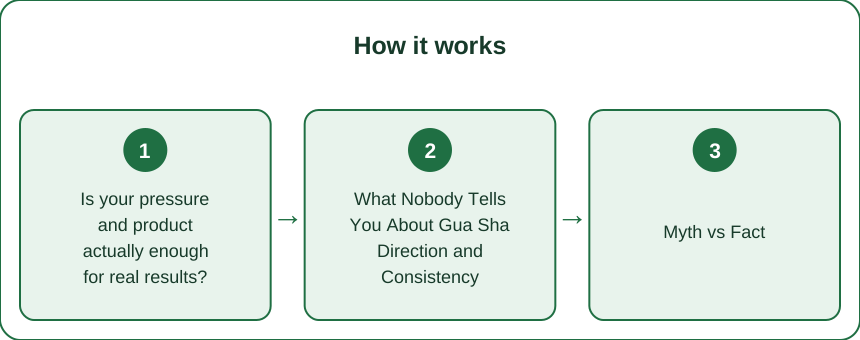
Is your pressure and product actually enough for real results?
Is my pressure actually strong enough?
Most beginners use noticeably lighter pressure than is needed for visible lymphatic drainage or muscle tension release — a firm, sustained pressure (similar to a moderately firm massage, not a light caress) is generally what studies and practitioners describing visible results actually use, not the featherlight strokes common in relaxation-focused tutorials.
Am I using enough product for the tool to glide properly?
Dry-skin gua sha, or using too little oil, creates friction that can irritate skin without allowing the tool’s edge to actually press into and move tissue — a generous layer of facial oil or a slippery serum is functionally necessary, not optional, for proper technique.
What Nobody Tells You About Gua Sha Direction and Consistency
Here’s the detail most quick tutorials skip: direction matters for lymphatic drainage specifically — strokes should generally move toward lymph nodes (down the neck, toward the ears and collarbone), not randomly across the face, since lymphatic fluid needs a consistent directional path to actually drain rather than just being pushed around.
Inconsistent daily practice (some days 30 seconds, some days skipped entirely) also underperforms compared to a shorter but genuinely consistent routine — the depuffing effect in particular tends to be cumulative and reverses quickly without regular practice, more like a fitness habit than a one-time treatment.

Myth vs Fact: Gua Sha Results
Myth: Any visible redness during gua sha means it’s working. Fact: Mild, temporary redness from increased blood flow is normal, but excessive redness or irritation usually signals too much pressure on unprotected dry skin, not more effective treatment — that’s a technique problem, not a good sign.
Myth: A more expensive stone tool produces better results than a basic one. Fact: Tool material (jade, rose quartz, stainless steel) matters far less than technique, pressure, and consistency — a correctly used basic tool outperforms an expensive tool used with poor technique.
Myth: Gua sha permanently changes facial structure. Fact: Visible effects like reduced puffiness and temporary contour definition are largely from fluid movement and muscle relaxation, and they fade without continued practice — it’s a maintenance habit, not a one-time structural change.
What does an actual effective routine look like?
- Cleanse first, then apply a generous layer of facial oil — enough that the tool glides without dragging or catching
- Firm, sustained pressure — enough that you feel real contact, short of pain or excessive redness
- Consistent direction — outward and downward toward lymph nodes at the jaw, ear, and collarbone, not random strokes
- 5-10 minutes daily, or at minimum every other day — consistency drives the cumulative depuffing effect more than any single long session
FAQ: Gua Sha Technique Questions, Answered
How long before I’d see any visible difference with corrected technique?
Immediate, temporary depuffing is common right after a session; more lasting contour or tension changes typically need 3-4 weeks of consistent daily or near-daily practice to become noticeable.
Can gua sha make puffiness worse if done incorrectly?
Yes — pressing too hard on lymph node areas, or using the wrong direction consistently, can occasionally cause temporary increased puffiness rather than drainage, which is a sign to revisit direction and pressure.
Should gua sha replace other skincare steps?
No — it’s a complementary technique layered onto a normal skincare routine (cleansing, moisturizing, sun protection), not a replacement for any of those fundamentals.
TL;DR:
- Insufficient pressure and too little oil are the two most common reasons daily gua sha shows no results
- Direction matters — strokes should move toward lymph nodes, not randomly across the face
- Tool material matters far less than technique, pressure, and genuine daily consistency
- Expect immediate temporary depuffing, but 3-4 weeks of consistent practice for more lasting effects
Keep Reading
This article is for general informational and styling purposes only. Fit, sizing, and product availability may vary.