Rose Quartz vs Jade vs Steel: Does Gua Sha Tool Material Actually Matter?
Quick Answer: The mechanical benefits of gua sha — lymphatic movement, temporary depuffing — come from the technique and pressure, not the stone type. Material mainly changes temperature retention, durability, and how the tool feels against skin, which matters for consistency more than results.
Social feeds treat tool material like it’s the secret variable, but the difference between a $12 rose quartz tool and a $60 jade one is smaller than most routines suggest.

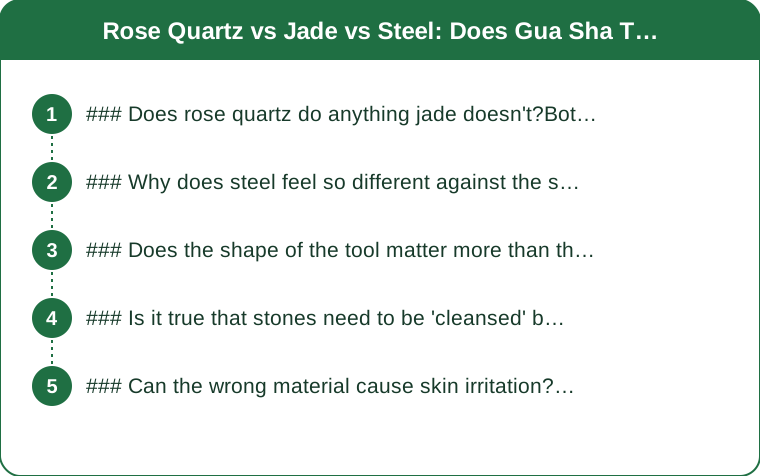
### Does rose quartz do anything jade doesn’t?
Both are quartz-family stones with similar thermal properties — neither one transmits meaningful ‘energy’ beyond what any smooth, cool stone provides. Any perceived difference in effect between the two is more likely due to tool shape or how consistently it’s used than the mineral itself. Rose quartz is marketed heavily for its pink color and association with self-care rituals, and jade for its long history in traditional practice, but neither has been shown to outperform the other functionally. Pick based on preference and tool shape, not marketed mineral properties.
### Why does steel feel so different against the skin?
Stainless steel conducts heat away from skin much faster than stone, so a chilled steel tool feels noticeably colder and stays cool longer during use, which some people find more satisfying for morning depuffing. Steel tools are also more durable — they won’t chip or crack the way stone can if dropped — and are easier to fully sanitize since the surface has no natural porosity. The tradeoff is a harder, less forgiving edge that requires slightly more care with pressure than a softer stone.

### Does the shape of the tool matter more than the material?
Yes, generally more than material — a tool with a properly curved edge that matches your jawline or cheekbone contour glides more effectively than a flat or mismatched shape regardless of what it’s made from. If you’re choosing between two tools of different materials but one has a shape that clearly matches your face better, prioritize the shape. A perfectly contoured steel tool will outperform a poorly shaped jade one for actual technique execution.
### Is it true that stones need to be ‘cleansed’ between materials?
This is a spiritual or ritual practice tied to some traditions around crystals, not a hygiene requirement — from a skin-safety standpoint, any tool just needs to be washed with soap and water or wiped with alcohol between uses. If cleansing rituals are meaningful to your personal practice, there’s no harm in continuing them, but they don’t substitute for actual cleaning, and skipping them poses no skin risk.
### Can the wrong material cause skin irritation?
Material itself rarely causes irritation directly, but a tool with a rough, unpolished edge — more common in cheap unbranded stone tools — can cause micro-abrasions regardless of what stone it claims to be. Buying from a source that shows the actual polished edge (not just a stock photo) reduces this risk more than choosing one mineral over another.
TL;DR:
- Stone type (rose quartz vs jade) makes little functional difference — pick based on preference
- Steel stays cooler longer and cleans more easily, but has a less forgiving edge
- Tool shape matching your face contour matters more than material for actual results
- A poorly polished edge, not the mineral itself, is the real irritation risk
Spend more time evaluating a tool’s shape and edge quality than agonizing over which stone claims the best properties.
Keep Reading
This article is for general informational and styling purposes only. Fit, sizing, and product availability may vary.