Gua Sha vs. Regular Facial Massage: Is the Tool Actually Doing Anything?
Quick Answer: A gua sha tool isn’t magic — its flat edge lets you apply firm, even pressure along a line that fingers can’t replicate as consistently. For depuffing alone, clean fingers work almost as well; for jawline definition and lymphatic flow, the tool has a real edge.
You’ve seen the before-and-afters. But if you’ve ever wondered whether that smooth stone is doing something your fingers physically can’t, the honest answer is: mostly, but not entirely.

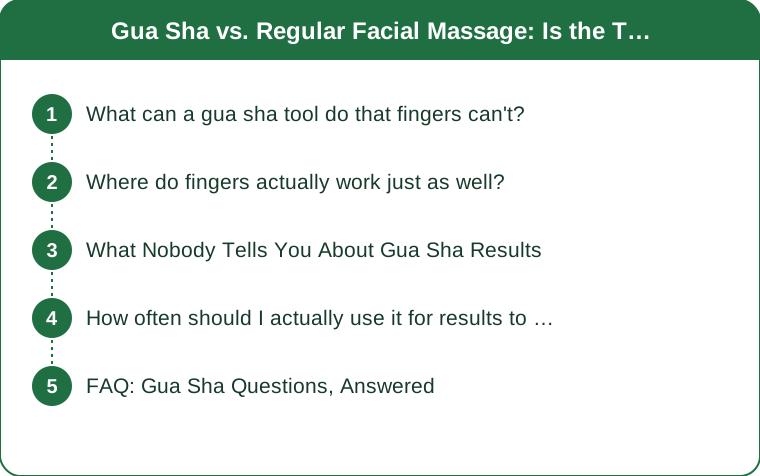
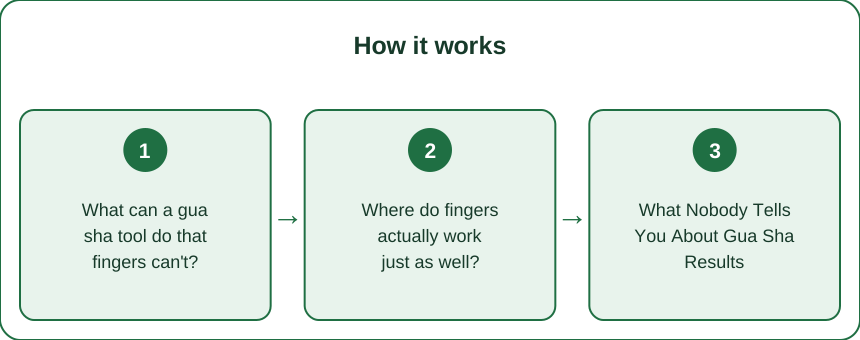
What can a gua sha tool do that fingers can’t?
The flat edge distributes pressure across a wider, more even contact area than a fingertip, which matters for lymphatic drainage — you want consistent gliding pressure, not spot pressure that stops and starts.
It also holds a consistent angle, roughly 15-30 degrees against the skin, which is hard to maintain with fingers over a 5-minute routine. That angle is what creates the smoothing effect people notice most on the jawline.
Where do fingers actually work just as well?
For general depuffing and circulation, clean fingertips with light oil perform close to a tool — the mechanism is mostly increased blood flow and lymph movement, which finger pressure does trigger.
Where fingers fall short is under the jaw and along the neck, where you need one continuous stroke. Fingers tend to press-and-release in that zone instead of gliding, which is the motion that actually matters.

What Nobody Tells You About Gua Sha Results
The “instant contour” you see after one session is water movement, not muscle change — it’s real, it’s just temporary, lasting a few hours to a day. Consistency over 4-6 weeks is what shows up in actual jawline definition, not one dramatic session.
And the tool matters less than technique: too much pressure causes micro-bruising that you might mistake for definition the next morning. If you see redness lasting past 20 minutes, you’re pressing too hard.
How often should I actually use it for results to show?
3-4 times a week, 5 minutes per session, is the sweet spot in most facial-massage research on lymphatic technique. Daily isn’t necessarily better and raises the risk of irritation, especially on thin under-eye skin.
Pair it with a facial oil, not dry skin — dragging a stone across dry skin is where most of the tugging and micro-damage happens.
FAQ: Gua Sha Questions, Answered
Do I need an expensive jade or rose quartz tool?
No. The stone type doesn’t change the mechanical effect — a $12 tool with the right edge shape works the same as a $60 one. Comfort in hand is the real difference.
Can gua sha replace facial massage entirely?
They’re the same category of tool, really — gua sha is just a more consistent delivery method for the same lymphatic-drainage technique.
Why does my jaw look more defined right after but not the next day?
That’s temporary fluid movement, not lasting change. Definition that sticks takes weeks of consistent practice, not one session.
TL;DR:
- The tool’s edge gives more even pressure and a consistent angle than fingers
- Fingers work nearly as well for general depuffing, just not along the jawline
- Redness past 20 minutes means too much pressure, not more results
- 3-4 sessions a week, 5 minutes each, with oil — not dry skin
The stone helps, but it’s the consistency of your routine, not the crystal, doing the real work.
Keep Reading
This article is for general informational and styling purposes only. Fit, sizing, and product availability may vary.