Gua Sha With Retinol and Actives: Your Questions, Answered
Quick Answer: Do not gua sha on the same night you apply a retinoid or a strong exfoliating acid. Both compromise the barrier temporarily, and mechanical friction on a compromised barrier is how people end up with redness they blame on the tool. Use gua sha in the morning or on non-retinoid nights, always over sufficient slip, and skip it entirely while your skin is actively peeling or irritated.
The tool is not the problem. The scheduling is.

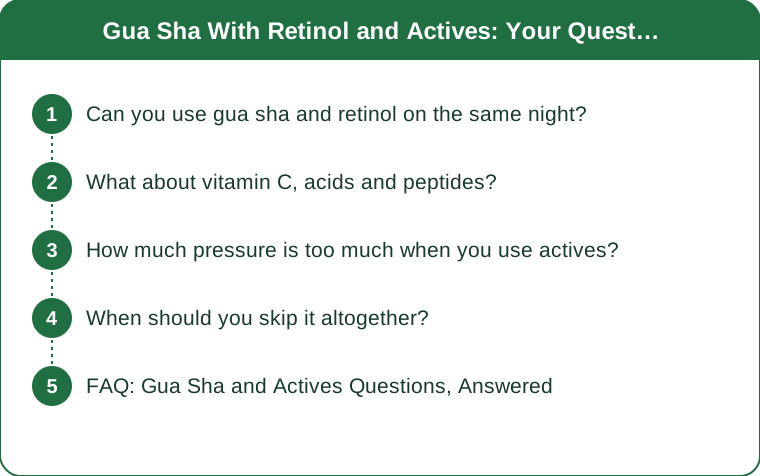
Can you use gua sha and retinol on the same night?
Better not to, and the reason is mechanical rather than chemical.
Retinoids increase cell turnover, which during the adjustment period means a thinner, more permeable stratum corneum and a temporarily less resilient barrier. Gua sha applies sustained directional pressure and friction across the skin surface. Combining a mechanically stressed surface with a chemically thinned one is where redness, stinging and small flaking patches come from.
The specific risk window is the first eight to twelve weeks on a retinoid, or any period after increasing strength or frequency. Once your skin is fully adapted and not flaking, the risk drops considerably — but the sensible default remains separation.
How to schedule it instead:
- Morning gua sha, evening retinoid. The cleanest split, and morning is when facial puffiness is greatest anyway, which is where gua sha does its most visible work.
- Alternate nights. If you use a retinoid three nights a week, gua sha on two of the off nights.
- Never on a night your skin already feels tight or sensitized. That is the signal to skip regardless of the calendar.
What about vitamin C, acids and peptides?
They separate into three tiers.
Fine to combine — apply first, then gua sha over an oil:
- Peptides
- Niacinamide
- Hyaluronic acid
- Ceramide creams
None of these compromise the barrier, and several actively support it. Layer them, then add facial oil and use the tool.
Use caution — separate by time of day:
- Vitamin C, particularly L-ascorbic acid at higher concentrations. It is acidic and can sting on freshly worked skin. If you use it in the morning, do gua sha at night.
- Benzoyl peroxide, which is both drying and capable of staining a light-colored stone tool.
Do not combine on the same session:
- AHAs and BHAs, especially at higher percentages
- Any leave-on peel
- Any prescription topical for acne or rosacea, unless your prescriber has said otherwise
The universal requirement, whatever you are using: enough slip. Gua sha on dry skin or on a light serum that has already absorbed is the fastest route to irritation, and it is the most common technique error. Facial oil or a rich balm, applied generously enough that the tool glides with no drag.

How much pressure is too much when you use actives?
Less than you think, and the calibration changes depending on what your routine contains.
The baseline standard: the tool should glide, not drag. If you can feel resistance or see the skin pulling and releasing under the edge, you are using too much pressure, too little slip, or both.
A useful test: the skin should show a light, even flush that resolves within 10 to 15 minutes. Blotchy patches, distinct red lines that follow the tool path, or any redness lasting more than about half an hour means you overdid it.
On an actives-heavy routine, reduce further. If you use a retinoid at all, treat your normal pressure as your maximum and work below it. Skin that is turning over faster bruises and irritates more readily.
Where to be most careful: under the eyes, where the skin is thinnest; along the jaw where people naturally press hardest chasing definition; and anywhere with active breakouts, which should simply be worked around rather than over.
What extra pressure does not do: it does not increase results. The mechanism is lymphatic movement and superficial circulation, both of which respond to light, repeated, directional strokes. Pressing harder recruits nothing extra and adds all of the risk.
When should you skip it altogether?
Six situations where the answer is simply not today.
Active peeling or flaking. Whether from a retinoid, an acid, sunburn or weather. Friction over a compromised surface makes the flaking worse and can create raw patches.
Active inflammatory acne. Working a tool over inflamed papules and pustules can spread bacteria across the face and increases the risk of post-inflammatory marks. Work around them, or skip the area.
After a professional treatment. Chemical peels, microneedling, laser — follow the practitioner’s aftercare timeline, which typically means no manual tools for at least a week and often longer.
Any active skin infection, including cold sores. A tool moving across the face during an outbreak is a transmission route across your own skin.
Immediately after injectables. Most practitioners advise avoiding facial manipulation for a period afterward. Ask yours for the specific window rather than guessing.
Any unexplained new lesion, lump or persistent redness. That is a reason to see a clinician, not a reason to massage it. This is general information, not medical advice.
And the practical one: if your skin already feels hot, tight or reactive today, the tool adds to that. Skipping a session costs nothing — gua sha benefits are cumulative and forgiving of gaps.
FAQ: Gua Sha and Actives Questions, Answered
Does gua sha make actives penetrate better?
Not in a way that has been demonstrated, and the framing is risky — if it did increase penetration of a retinoid or an acid, that would be a reason for caution, not enthusiasm. Use the tool for its own mechanism and let the actives work on their own schedule.
Can I use gua sha over sunscreen in the morning?
Better not to. You will disturb the film and reduce coverage, and the friction on a product designed to sit on the surface adds drag. Do gua sha before sunscreen, as the last step before SPF.
What oil should I use if my skin is acne-prone?
Lighter, lower-comedogenic options like squalane or hemp seed oil are generally well tolerated and give plenty of slip. A gel-textured slip product also works. What you want to avoid is thick occlusive balms if you are already breakout-prone.
How do I clean the tool if I use actives?
Wash it with mild soap and warm water after every use and dry it fully. Residue from oils and actives builds up on the stone and on textured edges, and a tool used on skin day after day without cleaning is a genuine hygiene issue.
TL;DR:
- Do not gua sha on the same night as a retinoid or a strong acid — separate by time of day or by night.
- Peptides, niacinamide, hyaluronic acid and ceramides layer fine underneath.
- Always use enough oil that the tool glides with zero drag; light pressure only.
- Skip entirely during peeling, active acne, after professional treatments, or when skin feels reactive.
- Gua sha before sunscreen, never over it, and wash the tool after every session.
Most gua sha irritation is a scheduling problem wearing a technique costume. Fix the calendar and the tool becomes uneventful.
Keep Reading
This article is for general informational and styling purposes only. Fit, sizing, and product availability may vary.